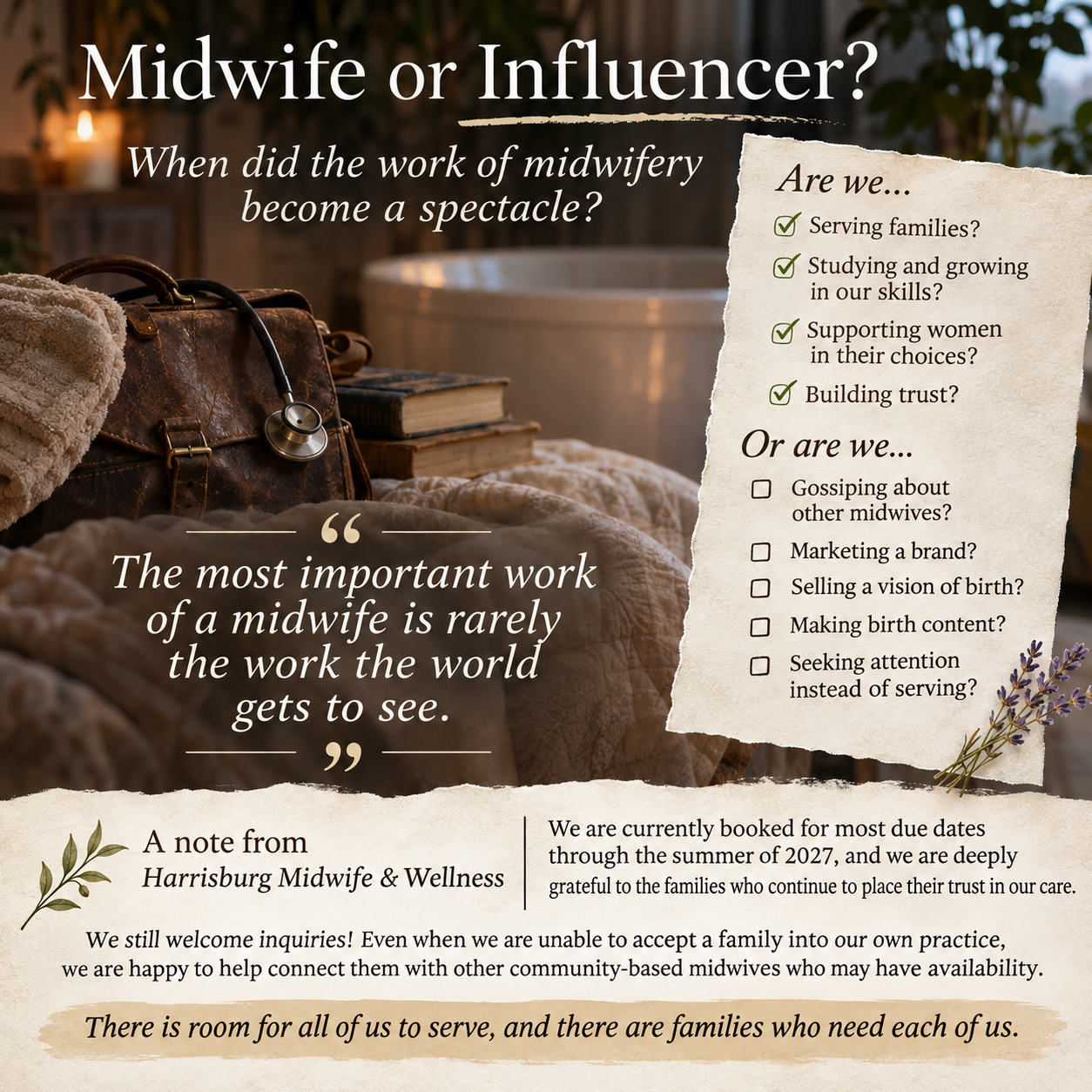
When did the work of midwifery become a spectacle?
There is a question worth asking within the natural birth and homebirth community today:
Are we busy being midwives, or are we busy being seen as midwives?
Are we spending our time serving families, studying, improving our skills, mentoring apprentices, and being present for the women who have entrusted us with their care?
Or are we spending our time gossiping about other midwives, questioning their work publicly, building brands, selling products, and promoting a particular vision of midwifery?
There is a difference between doing the work and marketing the image of the work.
Midwifery has never been an easy vocation
It demands sacrifice. Starting with the midwife’s ego.
It means many nights of interrupted sleep.
And rearranging prenatal appointment schedules. Sometimes repeatedly.
And missed family gatherings. Even holidays.
And long hours when yesterday turned into today and maybe tomorrow will become today, too.
And difficult decisions. Or difficult conversations while we watch a family struggle to make a necessary decision for their family.
And the willingness to sit quietly beside a woman for as long as she needs us.
Much of the most meaningful work a midwife does will never be photographed, recorded, or shared.
And perhaps that is exactly how it should be.
When the focus shifts from mother to midwife
Social media has changed the way natural birth is presented to the world.
Families are increasingly exposed to curated homebirth experiences, dramatic birth videos, idealized outcomes, and influencers who present a particular version of what birth should look like.
There is value in sharing birth stories.
Women have always learned from one another, and respectful storytelling can educate, encourage, and restore confidence in physiological birth.
But there is a fine line between sharing experiences and creating expectations.
When birth becomes content, the focus can shift from the woman having the baby to the person presenting the experience.
When the midwife becomes the personality, the brand, the authority, or the centerpiece of the story, something important risks being lost.
Even a post presented as advocacy can be deceptive when its underlying purpose is self-promotion.
We should always ask:
Who truly benefits from the attention?
The families seeking access to midwifery care, the profession and the communities we serve, or the midwife whose name, image, and personal brand are being elevated?
Advocacy should bring attention to the needs and rights of families, not become another opportunity to make the midwife the center of the story.
The birth does not belong to the midwife
It belongs to the mother, the baby, and the family whose lives are forever changed by that experience.
The danger of selling a vision
There is nothing inherently wrong with a midwife offering educational materials, teaching classes, earning a living, or maintaining a professional online presence.
But we should be willing to ask difficult questions about what happens when marketing becomes more prominent than service.
Are families being given balanced, individualized information, or are they being sold an idealized version of natural birth?
Are they being encouraged to understand their individual circumstances and make thoughtful decisions, or are they being encouraged to identify with a movement, a philosophy, or a personality?
Are we helping women develop confidence in themselves, or encouraging them to seek validation through the experiences they see online?
A post or single perspective will never convey the whole picture
A beautiful homebirth video cannot communicate every clinical assessment, every conversation about risk, every difficult judgment, or every contingency plan that may have existed behind the scenes.
And when only the beautiful moments are shared, women may develop unrealistic expectations about what birth should be.
What about how we (as midwives) treat others?
There is another troubling side of this culture.
Midwives who spend considerable time criticizing other midwives, spreading gossip, engaging in public disputes, or positioning themselves as superior representatives of the profession should consider what that behavior contributes to the community.
Accountability is important
Honest discussion of safety, professional conduct, and adverse outcomes is necessary.
But accountability is not gossip.
Gossip won’t call others to be more accountable either.
Professional disagreement is not an invitation to publicly humiliate another practitioner.
And tearing down another midwife does not make someone more qualified, more ethical, or more devoted to the families they serve.
There is enough meaningful work to be done in our own communities without making other midwives the focus of our public identities.
The quiet work still matters
And it matters more than ever now.
The work we do with families matters more than how many followers, or how many likes a post received, or how many shares or viral posts go out for a particular page.
The midwives I respect most are not necessarily the ones with the largest audiences, the most polished websites, or the greatest social media following.
They are the ones who continue learning, who know their limitations, who take responsibility when things become difficult, who collaborate when necessary, and who recognize that every family deserves individualized care.
They are the midwives who show up.
Who listen.
Who serve.
Who understand that being trusted to enter a family’s most intimate moments is a privilege, not a marketing opportunity.
I find it deeply disappointing to see the sacrifices of midwifery turned into a spectacle, particularly when the attention shifts away from the women and families at the heart of the work.
Birth is not a media sensation. It is not a performance. And it is not a platform upon which a midwife should build her own importance.
There is room for education, advocacy, storytelling, and professional visibility. But those things should remain in service to families, not become the purpose of the profession.
Perhaps we should spend less time asking how midwifery looks to the world and more time examining how faithfully we are practicing it.
Are we building a brand, or are we building trust?
Are we selling a vision, or are we serving a family?
Are we trying to be influential, or are we trying to be good midwives?
Because at the end of the day, the true measure of a midwife is not how many people watched her work.
It is how she cared for the people who trusted her enough to invite her into their lives.